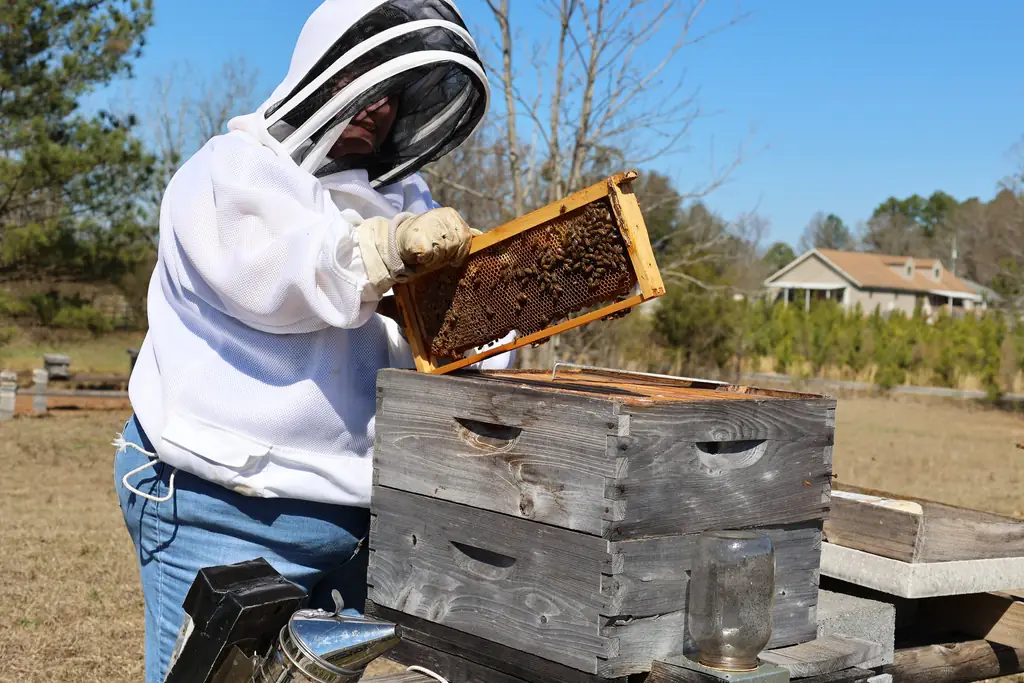
A two-hive apiary at the edge of an orchard. Clear and calm, 22 °C (72 °F), late morning. Two colonies, one of them yours to read. Nothing to sign in to, and your apiary stays on this device.
Saving Bees training
Learn to read a hive
Free, practical beekeeper training built on a living colony simulation. Open hives, gather evidence, make decisions, and watch what they do to the bees over the following weeks.

How it works
One loop, learned until it is a habit
Every scenario runs the same way a good beekeeper works a hive.
- 1LearnA short brief sets the scene: the season, the weather, what you knew last time.
- 2PracticeOpen a hive in your apiary. Lift the frames, use the lens, and write a record.
- 3ObserveEggs, larvae, caps, cells, stores, bees. The frames hold the evidence.
- 4DiagnoseChoose the explanation the evidence supports, and say how sure you are.
- 5IntervenePick an action with a cost, and decide when you will look again.
- 6EvaluateSee what happened inside the hive, skill by skill, with the sources.
- 7ProgressYour apiary keeps the result. The next scenario starts from it.
Start here
The quiet brood nest
Hive Willow has been quieter at the entrance this week. Open it, read the frames, record what you see, and decide what the colony needs.
Modules
From the first hive to the independent beekeeper
Each module introduces a skill, gives a safe place to practise it, measures the performance, and feeds the result into the apiary.
- Module 1In development
Your first hive
The parts of a hive, protective equipment, a safe inspection, and the queen, workers, drones, brood, and stores you will meet.
- Inspection technique
- Observation accuracy
- Module 2Practice in the apiary
Read the frames
Eggs, larvae, capped brood, pollen, nectar, and honey. What a steady brood pattern looks like, and what normal variation is.
Open Orchard, the reference hive in your apiary, and compare its frames with your notes.
- Observation accuracy
- Inspection technique
- Module 3Playable now
Diagnose the colony
Gather evidence, weigh the explanations, choose an intervention, and watch what it does to the colony over the following weeks.
- Diagnostic reasoning
- Intervention selection
- Timing and prioritization
- Recognizing uncertainty
- Colony welfare
- Resource use
- Module 4Planned
Seasonal management
Spring build-up, swarm season, summer dearth, the honey flow, and winter preparation. Anticipate needs instead of reacting to problems.
- Timing and prioritization
- Colony welfare
- Module 5Planned
The apiary manager
Several colonies, limited equipment, labor, and operating costs. Balance growth, production, colony welfare, and a sustainable budget.
- Resource use
- Timing and prioritization
- Module 6Planned
The independent beekeeper
Open-ended scenarios with less guidance. Prioritize inspections, allocate resources, respond to surprises, and show competence through practice.
- Diagnostic reasoning
- Intervention selection
- Timing and prioritization
- Recognizing uncertainty
- Colony welfare
- Resource use
Educational integrity
Sourced, simplified, and honest about both
Every statement a scenario makes links to a university extension service or a peer-reviewed source. The simulation is a model: the report says which parts are facts and which are gameplay.
No invented protocols
No dosages, no product names, no universal rules. Where practice varies by region and season, the scenario says so and points you to local guidance.
Competence, not completion
The report scores eight skills from what you did, not from what you clicked through. You can finish a scenario without demonstrating competence.
Nothing leaves this device
Your apiary and your attempts live in this browser. No account, no identifier, no time of day. One button forgets it all.
Sources behind the first scenario
- The Colony and Its Organization, Mid-Atlantic Apiculture Research and Extension Consortium (MAAREC), University of Delaware, with Penn State University
- Beekeeping Basics (agrs93), Penn State Extension, with MAAREC
- An Introduction to Queen Honey Bee Development, Penn State Extension
- Beekeeping: Cell Builder Basics, Penn State Extension
- Methods of Introducing Queens (E-277-W), April 2024, Purdue University Extension Entomology, with Penn State University
- What Is Bee Brood? (USU Extension Answers), Utah State University Extension
- How Can I Tell if My Queen Is Healthy? (USU Extension Answers), Utah State University Extension
- How Can I Identify a Queen Bee? (USU Extension Answers), Utah State University Extension
- What Should I Look for When Inspecting My Beehive? (USU Extension Answers), Utah State University Extension
- How Often Should I Inspect My Beehive? (USU Extension Answers), Utah State University Extension
- Using Nucs in Beekeeping Operations (ENY153/IN869), University of Florida IFAS Extension