Honey varieties
Thyme honey
Bees make this honey from the nectar of wild thyme on dry Mediterranean hillsides.
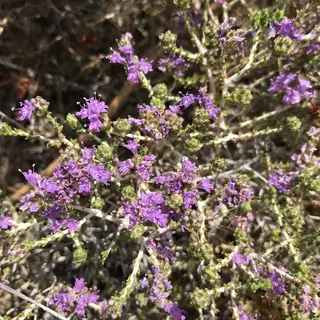 Thymbra capitatanectar
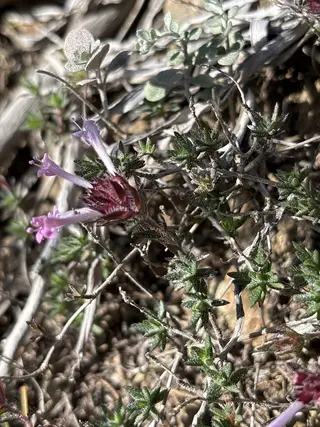 Thymusnectar
White to light amber
Thyme honey
The honey
- Color
White to light amber · 33 to 84 mm Pfund
Twelve Cretan thyme honeys measured 33 to 84 mm Pfund and averaged 61.4 mm Pfund. [1]
Illustrative screen color. A screen cannot show a laboratory color.
- Aroma
An intense aroma of the animal type, with a sweaty note. [2]
- Crystallization
Medium. A moderate tendency to crystallize in a creaming trial. [4]
Where it comes from
Thyme
Thymbra capitata, Thymus Genus
primary source · nectar
Published honey references and standards name this source. In other regions, the honey can come from more or different species.
- Documented in
- Greece, Spain, New Zealand
The catalog names these countries. Honey of this type can come from other regions too.
Dag Endresen published the photo of Thymbra capitata on iNaturalist under CC0 1.0: iNaturalist observation 14295103 (opens in a new tab).
Peter Gabler published the photo of Thymus integer on iNaturalist under CC0 1.0: iNaturalist observation 263063894 (opens in a new tab).
Evidence
At least one peer-reviewed study of this honey from a relevant region supports the color and a taste or smell value.
Peer-reviewed studies of authentic thyme honeys from Crete, Spain, and Greece give the values. The USDA grading manual groups thyme honey with the strong honeys.
Studies
Quantification of Hydrogen Peroxide in Cretan Honey and Correlation with Physicochemical Parameters
Alygizou, A., Grigorakis, S., Gotsiou, P., Loupassaki, S., Calokerinos, A.
Journal of Analytical Methods in Chemistry, 2021
30 authentic Cretan honeys, including 12 thyme and 3 citrus honeys, with Pfund color.
DOI: 10.1155/2021/5554305 (opens in a new tab) · Open the source (opens in a new tab)
How soil type (gypsum or limestone) influences the properties and composition of thyme honey
González-Porto, A., Martín Arroyo, T., Bartolomé Esteban, C.
SpringerPlus, 2016
70 pollen-checked thyme honeys from La Alcarria, Spain, with Pfund color and an expert tasting panel.
DOI: 10.1186/s40064-016-3243-9 (opens in a new tab) · Open the source (opens in a new tab)
Extracted Honey Grading Manual
U.S. Department of Agriculture, Agricultural Marketing Service, 1985
The USDA manual for honey graders describes the main U.S. floral sources and groups them by flavor.
Physicochemical and Rheological Characteristics of Monofloral Honeys—Kinetics of Creaming–Crystallization
Polatidou, K., Nouska, C., Tananaki, C., Biliaderis, C., Lazaridou, A.
Foods, 2025
Greek monofloral thyme, cotton, and heather honeys followed through a creaming trial.
DOI: 10.3390/foods14101835 (opens in a new tab) · Open the source (opens in a new tab)
Main European unifloral honeys: descriptive sheets
Persano Oddo, L., Piro, R.
Apidologie, 2004
The International Honey Commission descriptive sheets of the main European unifloral honeys.
References
- Main European unifloral honeys: descriptive sheets — International Honey Commission
- Standard for Honey CXS 12-1981 — FAO / WHO Codex Alimentarius
- Council Directive 2001/110/EC relating to honey — European Union
- Criteria for identifying monofloral and multifloral manuka honey — New Zealand Ministry for Primary Industries
- United States Standards for Grades of Extracted Honey — United States Department of Agriculture
- Honey for nutrition and health: a review — Journal of the American College of Nutrition
We reviewed this record on .