Honey varieties
Pine honey
Bees make this honeydew honey from the sugary excretion of insects that feed on pine trees, not from flower nectar.
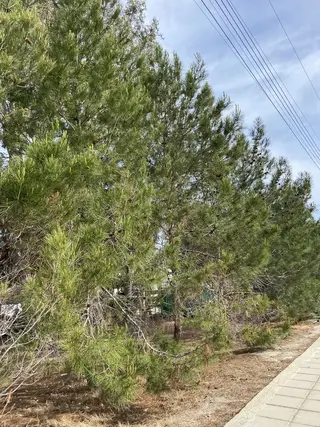 Pinus brutiahoneydew of Marchalina hellenica
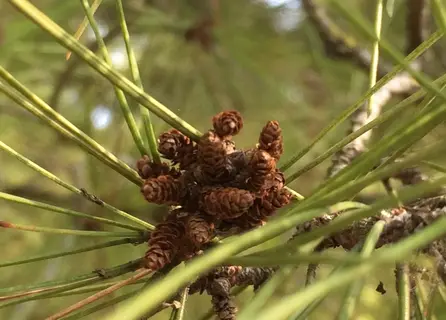 Pinus halepensishoneydew of Marchalina hellenica
Light amber to dark amber
Pine honey
The honey
- Color
Light amber to dark amber · 60 to 118 mm Pfund
Twenty-seven Greek pine honeys measured 60 to 118 mm Pfund and averaged 91.9 mm Pfund. [1]
Illustrative screen color. A screen cannot show a laboratory color.
- Aroma
- Not documented
- Flavor
- Not documented
- Crystallization
Its fructose-to-glucose ratio, 1.27 on average, points to a moderate tendency to crystallize. [1]
Where it comes from
Pine
Pinus brutia, Pinus halepensis
Honeydew of the insect Marchalina hellenica
primary source · honeydew
Published honey references and standards name this source. In other regions, the honey can come from more or different species.
- Also known as
- Pine honeydew honey
- Documented in
- Greece, Türkiye
The catalog names these countries. Honey of this type can come from other regions too.
Alex Gault published the photo of Pinus brutia on iNaturalist under CC0 1.0: iNaturalist observation 160743984 (opens in a new tab).
dbmhartley published the photo of Pinus halepensis on iNaturalist under CC0 1.0: iNaturalist observation 60332338 (opens in a new tab).
Evidence
Published evidence exists but is limited, for example a government or trade-board description or one small study.
A peer-reviewed study of 27 authenticated Greek pine honeys gives the color and the sugar ratio. No study that we read gives the aroma or the flavor yet.
Studies
Physicochemical Characterization and Biological Properties of Pine Honey Produced across Greece
Tsavea, E., Vardaka, F.-P., Savvidaki, E., Kellil, A., Kanelis, D., Bucekova, M., Grigorakis, S., Godocikova, J., Gotsiou, P., Dimou, M., Loupassaki, S., Remoundou, I., Tsadila, C., Dimitriou, T.G., Majtan, J., Tananaki, C., Alissandrakis, E., Mossialos, D.
Foods, 2022
27 authenticated Greek pine honeys, with Pfund color and sugar profiles.
DOI: 10.3390/foods11070943 (opens in a new tab) · Open the source (opens in a new tab)
Main European unifloral honeys: descriptive sheets
Persano Oddo, L., Piro, R.
Apidologie, 2004
The International Honey Commission descriptive sheets of the main European unifloral honeys.
References
- Main European unifloral honeys: descriptive sheets — International Honey Commission
- Standard for Honey CXS 12-1981 — FAO / WHO Codex Alimentarius
- Council Directive 2001/110/EC relating to honey — European Union
- Criteria for identifying monofloral and multifloral manuka honey — New Zealand Ministry for Primary Industries
- United States Standards for Grades of Extracted Honey — United States Department of Agriculture
- Honey for nutrition and health: a review — Journal of the American College of Nutrition
We reviewed this record on .