Honey varieties
Mānuka honey
Bees make this honey from the nectar of mānuka. New Zealand rules identify export mānuka honey with chemical markers and a DNA test.
 Mānukanectar
White to amber
Mānuka honey
The honey
- Color
- Aroma
- Not documented
- Flavor
- Not documented
- Crystallization
- Not documented
Where it comes from
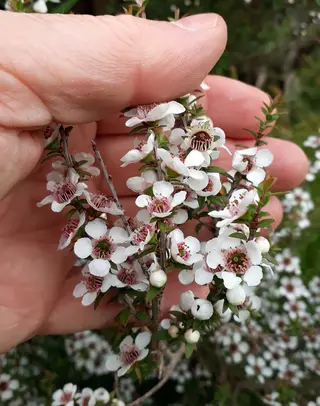
Mānuka
Leptospermum scoparium
primary source · nectar
Published honey references and standards name this source. In other regions, the honey can come from more or different species.
- Documented in
- New Zealand, Australia
The catalog names these countries. Honey of this type can come from other regions too.
Peter de Lange published the photo of Leptospermum scoparium on iNaturalist under CC0 1.0: iNaturalist observation 9593850 (opens in a new tab).
Evidence
Published evidence exists but is limited, for example a government or trade-board description or one small study.
Two peer-reviewed studies measured the color of three commercial mānuka honeys. No study that we read gives the aroma, the flavor, or the crystallization yet.
Studies
Comparison of Antioxidant Properties and Color of Selected Polish Honeys and Manuka Honey
Majewska, E., Drużyńska, B., Derewiaka, D., Ciecierska, M., Pakosz, P.
Foods, 2024
Polish honeys and one commercial manuka honey, with Pfund color for each sample.
DOI: 10.3390/foods13172666 (opens in a new tab) · Open the source (opens in a new tab)
Physicochemical Composition of Local and Imported Honeys Associated with Quality Standards
Raweh, H.S.A., Badjah-Hadj-Ahmed, A.Y., Iqbal, J., Alqarni, A.S.
Foods, 2023
40 local and imported honeys in Saudi Arabia with pollen checks and Pfund color, including sidr and manuka honeys.
DOI: 10.3390/foods12112181 (opens in a new tab) · Open the source (opens in a new tab)
References
- Main European unifloral honeys: descriptive sheets — International Honey Commission
- Standard for Honey CXS 12-1981 — FAO / WHO Codex Alimentarius
- Council Directive 2001/110/EC relating to honey — European Union
- Criteria for identifying monofloral and multifloral manuka honey — New Zealand Ministry for Primary Industries
- United States Standards for Grades of Extracted Honey — United States Department of Agriculture
- Honey for nutrition and health: a review — Journal of the American College of Nutrition
We reviewed this record on .