Honey varieties
Longan honey
Bees make this honey from the nectar of longan orchards in Southeast and East Asia.
 Longannectar
Light amber to dark amber
Longan honey
The honey
- Color
Light amber to dark amber · 50.8 to 183.1 mm Pfund
Ten longan honeys from Taiwan and Thailand measured 51 to 183 mm Pfund. [1]
Illustrative screen color. A screen cannot show a laboratory color.
- Aroma
Aromatic. Its marker compounds include lilac alcohols, which smell green, grassy, and fresh. [1][2]
- Flavor
- Not documented
- Crystallization
- Not documented
Where it comes from
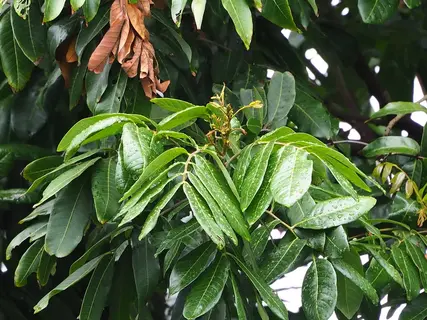
Longan
Dimocarpus longan
primary source · nectar
Published honey references and standards name this source. In other regions, the honey can come from more or different species.
- Documented in
- Thailand, Vietnam, China
The catalog names these countries. Honey of this type can come from other regions too.
葉子 published the photo of Dimocarpus longan on iNaturalist under CC0 1.0: iNaturalist observation 181556903 (opens in a new tab).
Evidence
At least one peer-reviewed study of this honey from a relevant region supports the color and a taste or smell value.
A peer-reviewed study of 10 longan honeys from Taiwan and Thailand gives the color. A peer-reviewed study of Thai honeys gives the aroma compounds.
Studies
An Analysis of Longan Honey from Taiwan and Thailand Using Flow Cytometry and Physicochemical Analysis
Kafle, L., Mabuza, T.Z.
Foods, 2024
10 longan honeys from beekeepers in Taiwan and Thailand, with Pfund color.
DOI: 10.3390/foods13233772 (opens in a new tab) · Open the source (opens in a new tab)
Volatile organic compounds of Thai honeys produced from several floral sources by different honey bee species
Pattamayutanon, P., Angeli, S., Thakeow, P., Abraham, J., Disayathanoowat, T., Chantawannakul, P.
PLoS One, 2017
Aroma compounds of Thai honeys from several floral sources, including longan honey.
DOI: 10.1371/journal.pone.0172099 (opens in a new tab) · Open the source (opens in a new tab)
References
- Main European unifloral honeys: descriptive sheets — International Honey Commission
- Standard for Honey CXS 12-1981 — FAO / WHO Codex Alimentarius
- Council Directive 2001/110/EC relating to honey — European Union
- Criteria for identifying monofloral and multifloral manuka honey — New Zealand Ministry for Primary Industries
- United States Standards for Grades of Extracted Honey — United States Department of Agriculture
- Honey for nutrition and health: a review — Journal of the American College of Nutrition
We reviewed this record on .