Honey varieties
Lavender honey
Bees make this honey from the nectar of wild and cultivated lavender.
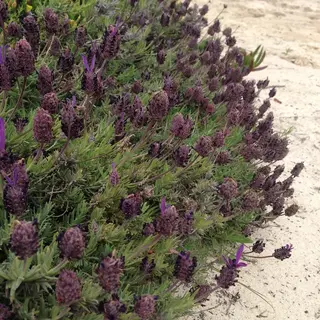 Lavendernectar
Lavender honey
Color not documented
The honey
- Color
- Not documented
- Aroma
Spanish lavender honey smells fresh and floral, with lavender, citrus, and balsamic notes. [1]
- Flavor
- Not documented
- Crystallization
- Not documented
Where it comes from
Lavender
Lavandula Genus
primary source · nectar
Published honey references and standards name this source. In other regions, the honey can come from more or different species.
- Documented in
- France, Spain
The catalog names these countries. Honey of this type can come from other regions too.
Dag Endresen published the photo of Lavandula stoechas on iNaturalist under CC0 1.0: iNaturalist observation 3022131 (opens in a new tab).
Evidence
Published evidence exists but is limited, for example a government or trade-board description or one small study.
A German expert report on honey tasting gives the aroma of Spanish lavender honey. No study that we read gives the color, the flavor, or the crystallization yet.
Studies
Sensory Analysis of Honey
Derndorfer, E.
DLG e.V. (German Agricultural Society), 2015
A German expert report on the sensory testing of honey.
Main European unifloral honeys: descriptive sheets
Persano Oddo, L., Piro, R.
Apidologie, 2004
The International Honey Commission descriptive sheets of the main European unifloral honeys.
References
- Main European unifloral honeys: descriptive sheets — International Honey Commission
- Standard for Honey CXS 12-1981 — FAO / WHO Codex Alimentarius
- Council Directive 2001/110/EC relating to honey — European Union
- Criteria for identifying monofloral and multifloral manuka honey — New Zealand Ministry for Primary Industries
- United States Standards for Grades of Extracted Honey — United States Department of Agriculture
- Honey for nutrition and health: a review — Journal of the American College of Nutrition
We reviewed this record on .