Honey varieties
Buckwheat honey
Bees make this dark honey from the nectar of buckwheat, a crop that farmers grow for its grain-like seeds.
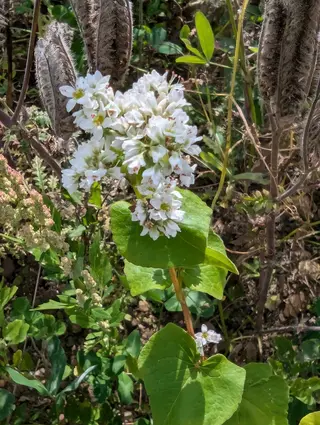 Buckwheatnectar
Buckwheat honey
Color class not documented
The honey
Where it comes from
Buckwheat
Fagopyrum esculentum
primary source · nectar
Published honey references and standards name this source. In other regions, the honey can come from more or different species.
- Documented in
- United States, Canada, Poland, Ukraine, China
The catalog names these countries. Honey of this type can come from other regions too.
Piermario Maculan published the photo of Fagopyrum esculentum on iNaturalist under CC0 1.0: iNaturalist observation 238658378 (opens in a new tab).
Evidence
At least one peer-reviewed study of this honey from a relevant region supports the color and a taste or smell value.
A peer-reviewed study of pollen-checked buckwheat honeys from four countries gives the color, aroma, and flavor. The U.S. National Honey Board adds the flavor notes.
Studies
Melissopalynological and Volatile Compounds Analysis of Buckwheat Honey from Different Geographical Origins and Their Role in Botanical Determination
Panseri, S., Manzo, A., Chiesa, L.M., Giorgi, A.
Journal of Chemistry, 2013
Pollen-checked buckwheat honeys from Italy, Poland, Russia, and Nepal, with their aroma compounds.
DOI: 10.1155/2013/904202 (opens in a new tab) · Open the source (opens in a new tab)
Honey Varietals
National Honey Board
The U.S. National Honey Board describes the color, aroma, and flavor of seven U.S. honey varieties.
References
- Main European unifloral honeys: descriptive sheets — International Honey Commission
- Standard for Honey CXS 12-1981 — FAO / WHO Codex Alimentarius
- Council Directive 2001/110/EC relating to honey — European Union
- Criteria for identifying monofloral and multifloral manuka honey — New Zealand Ministry for Primary Industries
- United States Standards for Grades of Extracted Honey — United States Department of Agriculture
- Honey for nutrition and health: a review — Journal of the American College of Nutrition
We reviewed this record on .