Honey varieties
Basswood honey
Bees make this honey from the nectar of linden trees, which people in North America call basswood.
 Linden (basswood)nectar
White to light amber
Basswood honey
The honey
- Color
White to light amber · 25 to 69 mm Pfund
Bulgarian linden honeys measured from 25 to 69 mm Pfund. [1]
Illustrative screen color. A screen cannot show a laboratory color.
- Aroma
A strong, fresh, vegetal aroma with some chemical notes. [1]
- Flavor
Medium sweet, with moderate acidity and a long, astringent aftertaste. [1]
- Crystallization
Sets into a compact mass of fine, light yellow crystals, sometimes with a green tint. [1]
Where it comes from
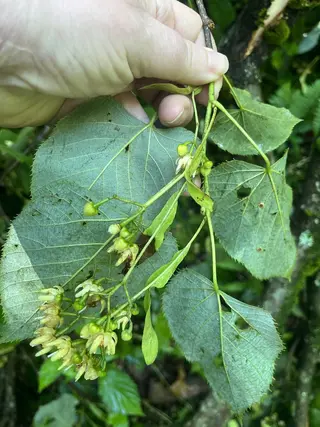
Linden (basswood)
Tilia Genus
primary source · nectar
Published honey references and standards name this source. In other regions, the honey can come from more or different species.
- Also known as
- Linden honey
- Documented in
- Poland, Ukraine, Romania, United States, China
The catalog names these countries. Honey of this type can come from other regions too.
Bonnie Isaac published the photo of Tilia americana on iNaturalist under CC0 1.0: iNaturalist observation 294988599 (opens in a new tab).
Evidence
At least one peer-reviewed study of this honey from a relevant region supports the color and a taste or smell value.
A peer-reviewed study of 18 pollen-checked Bulgarian linden honeys with a trained tasting panel gives every value.
Studies
Comparative Study of Bulgarian Linden Honey (Tilia sp.)
Yankova-Nikolova, A., Vlahova-Vangelova, D., Balev, D., Kolev, N., Dragoev, S., Lowndes-Nikolova, B.
Foods, 2025
18 linden honeys from six Bulgarian regions, with pollen analysis, Pfund color, and a trained tasting panel.
Main European unifloral honeys: descriptive sheets
Persano Oddo, L., Piro, R.
Apidologie, 2004
The International Honey Commission descriptive sheets of the main European unifloral honeys.
References
- Main European unifloral honeys: descriptive sheets — International Honey Commission
- Standard for Honey CXS 12-1981 — FAO / WHO Codex Alimentarius
- Council Directive 2001/110/EC relating to honey — European Union
- Criteria for identifying monofloral and multifloral manuka honey — New Zealand Ministry for Primary Industries
- United States Standards for Grades of Extracted Honey — United States Department of Agriculture
- Honey for nutrition and health: a review — Journal of the American College of Nutrition
We reviewed this record on .