Honey varieties
Acacia honey
Bees make this honey from the nectar of black locust trees.
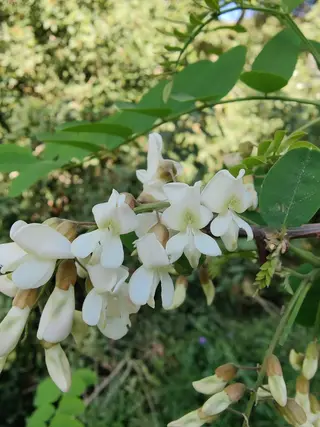 Black locustnectar
Water white
Acacia honey
The honey
- Color
Water white
Every pollen-checked sample from Hungary and Slovakia graded water white, the lightest color class. [1]
Illustrative screen color. A screen cannot show a laboratory color.
- Aroma
A weak floral odor, like black locust flowers, most clearly in fresh honey. [1]
- Flavor
Mild, sweet, and floral, with low acidity. [1]
- Crystallization
Slow. Stays liquid for a long time, because it has a high ratio of fructose to glucose. [2]
Where it comes from
Black locust
Robinia pseudoacacia
primary source · nectar
Published honey references and standards name this source. In other regions, the honey can come from more or different species.
- Also known as
- Black locust honey
- Documented in
- Hungary, Romania, Italy, Serbia, Bulgaria
The catalog names these countries. Honey of this type can come from other regions too.
Sarah Zukoff published the photo of Robinia pseudoacacia on iNaturalist under CC0 1.0: iNaturalist observation 77997851 (opens in a new tab).
Evidence
At least one peer-reviewed study of this honey from a relevant region supports the color and a taste or smell value.
A peer-reviewed study of 14 pollen-checked Hungarian and Slovak honeys gives the color, aroma, and flavor. A Hungarian study gives the crystallization.
Studies
Pseudoacacia Honey of Hungarian and Slovak Origin: Selected Quality Parameters and Antioxidant Capacity
Stehlíková, D., Farkas, Á., Filep, R., Papp, N., Purger, D., Tóth, J., Czigle, S.
Molecules, 2026
Ten Hungarian and four Slovak acacia honeys with pollen-checked origin, graded on the Pfund scale.
Classification of Acacia, Rape and Multifloral Hungarian Honey Types
Dominkó, E., Németh, Z.I., Rétfalvi, T.
Heliyon, 2024
A comparison of Hungarian acacia, rape, and multifloral honeys.
Main European unifloral honeys: descriptive sheets
Persano Oddo, L., Piro, R.
Apidologie, 2004
The International Honey Commission descriptive sheets of the main European unifloral honeys.
References
- Main European unifloral honeys: descriptive sheets — International Honey Commission
- Standard for Honey CXS 12-1981 — FAO / WHO Codex Alimentarius
- Council Directive 2001/110/EC relating to honey — European Union
- Criteria for identifying monofloral and multifloral manuka honey — New Zealand Ministry for Primary Industries
- United States Standards for Grades of Extracted Honey — United States Department of Agriculture
- Honey for nutrition and health: a review — Journal of the American College of Nutrition
We reviewed this record on .